Related Posts Plugin for WordPress, Blogger...
Showing posts with label patio. Show all posts

Wednesday, February 22, 2017

DIY: How To Oil A Timber Deck With Cabot's Aquadeck

I'm thrilled to work with Cabot's again, an Australian company, that is known for their quality wood oil and stain products on our new deck and patio project.

We tried Cabot's exterior stain to stain our new treated pine patio in 'new jarrah' and today I'm sharing a DIY on how to oil a timber deck using Cabot's Aquadeck.


For our new deck we decided to use an exterior oil instead of a stain because we love the look of the Merbau timber and want to enhance the natural look of the timber which is what an oil does and to protect it from the weather and elements and also from general wear and tear.

You need to leave new wood to settle for a few weeks before oiling it (its best to check the manufacturers directions for this) - our Merbau timber was out in the weather for over 6 weeks before we oiled it.

To oil a new timber deck that hasn't been oiled before this is what we used:


DIY: How to oil a timber deck

1. Pick the oil - We chose Aquadeck in 'Natural' as we want to enhance the look of our Merbau timber and the Aquadeck applies a clear protective coating to the timber but it doesn't stain or change the colour.

2. Clean the deck - Preparation is the key to a successful DIY so make sure the wood surface is clean of any dirt.

We pressure cleaned the deck with our trusty Karcher High Pressure Cleaner which you attach the hose to.

Then we gave the deck a scrub clean - you need to use proper cleaning products suitable to wood and we used Cabot's Deck Clean and applied it with the Cabot's Deck Prep which was a scrubbing brush on a pole and great for getting marks off the timber.

The Cabot's Deck Hand Bucket is really handy as it shows you how far to fill the deck clean too and then how far to top it up with water so no measuring required.

After we cleaned the deck we left it overnight to ensure it was completely dry.

Lastly, we went over it with the vacuum to ensure it was clean and ready to be oiled. We have a Karcher wet/dry vacuum which we use just for our renovations so we don't dirty or damage our inside vacuum.


3. Oil the deck - It's really important that the deck is dry before you oil it so we waited 24 hours before applying the first coat of oil just to be sure it was completely dry.

Give the oil a really good stir with a stick and then decanter some into a bucket - we used the Cabot's Deck Hand Bucket as it fits the applicators perfectly and was easy to move around the deck.

To apply the oil we used a large flat paint brush to apply the oil all around the edges of the deck just as you would 'cut in' when you paint a room.

Then to apply the oil to the rest of the deck we used a Cabot's Decking Oil Applicator which is a lambs wool applicator on a pole and perfect for flat surfaces for the main areas of the deck. Dip the applicator into the oil and push flat to remove any excess as you don't want to apply the oil too thickly or it will take forever to dry.

Start from the far corner and move down in long even strokes aiming to cover 3-4 boards at a time, work slowly to ensure good coverage and no streaks are left behind.


4. First coat - The first coat of oil took about 1.5 hours to apply on a 10 meter long deck. The oil was a nice consistency and good to work with soaking into the timber and giving even coverage. It has a sheen to it which helps you see where you've applied the oil too and it has a very light brown pigment in it but is mostly transparent and once applied it evens out the colour of the wood to make all the wood look consistent.

5. Second coat - It is dry enough to re-coat after 2 hours however we left it for 24 hours as it was still a bit sticky and tacky. The second coat took the same time to apply about 1.5 hours, after first cutting in with a brush and then applying with an applicator for the rest of the deck. We used a new lambs wool applicator for the second coat.

6. Drying time - It takes a week to cure completely although you can walk on it lightly we kept off it until the 7 days were up to ensure it was completely dry and set so it wouldn't mark or scratch. The weather and temperature has a lot to do with the drying time and as Perth had a cooler change in temperatures and our deck is covered and not in direct sunlight it was still a bit tacky after the first week and so we left it a total of 2 weeks to cure before we moved any furniture onto it.

7. Coverage & Maintenance - A 10 ltr tin of oil did 2 coats with enough leftover for re-oiling down the track. The deck will need to be oiled every 1-2 years. Our deck is completely undercover of the patio so we may not need to re-oil it as often as it's protected from the elements.

Cabot's have a Deck Wash which you can use between oiling to remove any build up and debris which will be what we will do next time rather than oil it again too soon.


8. Clean up - The oil is water based which makes clean up really easy just wash the brush out with water. We didn't keep the lambswool applicators we threw them after use. I prefer to use water based products as there's little to no smell and clean up is easy without the use of chemicals or cleaning products.

And that is an easy weekend project of oiling and protecting a timber deck to enhance the natural timber and protect from wear and tear and the weather.

The new deck and patio space looks amazing I can't wait to set it up with our outdoor furniture and BBQ and enjoy our outdoor entertaining space.


Sharing with link parties:
Curly Crafty Mom - The Creative Corner
Savvy Southern Style - Wow Us Wednesdays
The Dedicated House - Make It Pretty Mondays


Disclosure: Thanks to Cabot's for providing me with the oil products for review. I have not received any payment or compensation. As always, all opinions are my own.

 photo F0F68C01A59FABD46732FC15E1D8816D_zpsc6047f2f.png

For exclusive extras and daily updates ... follow Jarrah Jungle on Facebook, Instagram and Twitter


[All images my own]

Pin It Now!

Wednesday, February 15, 2017

DIY: How To Stain A Pine Patio In 7 Easy Steps With Cabot's

I am thrilled to work with Cabot's an Australian company known for their quality wood oil and stain products on our new deck and patio project.

We tried their exterior product range for oiling our new timber deck and staining our new pine patio which I'll share in two separate blog posts.

So what is the difference between a stain and an oil ?

If you like the look of the timber and just want to protect it you use an oil - this is what we are using for our timber deck as its made from beautiful Merbau timber and we want to enhance the natural look of the timber and protect it. With an oil you paint it on and it absorbs in and drys like a clear coating so your natural timber can shine through in all its glory.

Whereas if you don't particularly like the look of the timber and want to change it to a different colour then you use a stain - this is what we are using for our treated pine patio because we don't like the look of pine and want to stain it a darker colour to match the Merbau timber deck.


What do you need to stain a pine patio ?

You don't need a lot for this DIY which keeps the cost down considerably, all you need is the stain, a paint brush, buckets and drop sheets that's it!
  • Stain - We used Cabots Deck and Exterior Stain (water based) in 'New Jarrah'
  • Paint brush - A wide angled brush works best for painting around framework
  • Small bucket - To decanter stain into and keep refilling as you work
  • Large bucket - Filled with water to wash brushes when finished
  • Drop sheets - To protect work area


How to stain a treated pine patio in 7 easy steps

1. Pick a colour - Once we decided to use a stain we had to pick a stain colour and narrowed it down to two colours New Jarrah and Marbau. We painted the stain onto some treated pine off-cuts to see which one we liked the best and the New Jarrah has a nice red tint to it whereas the Merbau was a bit too brown so we went with the New Jarrah. Besides how can I call my blog namesake Jarrah Jungle and not pick jarrah!

2. Get the site ready - Before you start be aware you need to leave new wood to settle for a few weeks before staining its best to check the manufacturers directions for this (our pine was out in the weather for over 4 weeks before we stained it). Make sure the woods surface is clean of any dirt or dust before you start, we used rags to wipe the pine clean. Put down drop sheets to protect the ground from any drips (in our case our beautiful new deck!) and you are good to go. We worked from a scaffold which made it so much easier and safer to access the patio from that height.

3. Get the stain ready - Give the stain a good stir with a stick and then decanter a small amount into a bucket to work from. Put the lid back on the stain to keep the air out so it stays in good condition. Keep refilling the bucket with stain as you need to.

4. Paint it on - Pick up your paint brush and start painting the stain on using long fluid strokes. Remember if you leave a blob of stain and come back a minute later it will dry like that blob because the stain absorbs into the wood. So clean up any drips and blobs as you go with the paint brush.


5. First coat - The first coat always takes the longest - it took us 10 hours to paint a 10 meter long patio with ceiling frame work and side poles. The stain absorbed quickly into the pine and it was really good to work with and gave great coverage. A 4 ltr tin of stain did the first coat.

6. Second coat - It is dry enough for re-coat after 2 hours however after 10 hours of staining spread over the weekend we didn't get around to doing the second coat until a few days later. The second coat always goes on a lot quicker than the first, uses less product, and best of all it took us half the time.  We used about 3 ltrs on the second coat.

7. Clean up - The stain is water based which makes clean up really easy just wash your brushes out with water. This is why I always prefer to use water based products - there's little to no smell and clean up is so easy without the use of chemicals or cleaning products.

And that my friends is how in 7 easy steps you can turn a treated pine patio
into a more expensive looking timber patio !


I am so happy with how it's turned out all thanks to Mr P who worked like a trooper in the hot summer heat to get the patio stained and ready for the carpenter to finish it off by installing the roof sheeting and new fence.

Coming up next I'll be writing a blog post on How to oil a timber deck using Cabot's exterior products.

What would you like to stain at home ... Outdoor furniture? A deck? Something else!


Sharing with link parties:
Curly Crafty Mom - The Creative Corner
The Dedicated House - Make It Pretty Monday
Savvy Southern Style - Wow Us Wednesdays


Disclosure: Thanks to Cabot's for providing me with these stain products for review. I have not received any payment or compensation. As always, all opinions are my own.

 photo F0F68C01A59FABD46732FC15E1D8816D_zpsc6047f2f.png

For exclusive extras and daily updates ... follow Jarrah Jungle on Facebook, Instagram and Twitter


[All images my own]

Pin It Now!

Wednesday, February 8, 2017

Backyard Progress: Patio Build + Fence Install

Following on from last weeks backyard progress blog post and our new timber deck being built as part of this design we also had the carpenter build a patio to sit over the deck.

The patio comes directly off our house and will be like an outdoor room where we can BBQ, dine, chill out and entertain.

Firstly, the treated pine patio posts were core drilled into our new limestone retaining wall for strength and support. Once the patio was finished the carpenter installed a Colorbond fence (the same as the new side fence) along the retaining wall and these patio posts will form the support posts for the fence. 


The frame is all made from treated pine which we will stain to look like a more expensive timber.

We went with a peaked roof design rather than a flat roof so it has a higher ceiling and gives the illusion of more space. 


Mr P and I got busy on a stinking hot 40 degree weekend and stained all the patio posts and ceiling beams and transformed the treated pine into a beautiful looking timber.

This had to be done before the carpenter could install the roof sheeting.

I'll be writing a separate blog post on How to stain a treated pine patio in 7 easy steps using Cabot's exterior products. Here are a few sneak peeks of us staining the patio and when I say "us" of course I mean Mr P did all the work while I kept him replenished with icy cold drinks, snacks and words of encouragement!


We spent the weekend applying the stain and then the carpenter returned during the week to install the metal roof sheeting.

For roof colours we picked Colorbond - Shale Grey which is a light grey as we thought the lighter colour would be a bit cooler and the grey tones suit our tile roof colour which is Colorbond - Monument and is a very dark charcoal.

We also added some sheer roof sheeting to let light in as we were worried the closed in roof would make the inside of our house too dark - we picked the sheer roof sheeting in a 60% tint.

The house is a bit darker now that the patio roof is on, even with the tinted sheets, so it was a good idea to include these otherwise it would be so dark we would need to turn lights on during the day which is not what we want to do.


For some colour contrast we painted the treated pine ceiling beams white so that the stained timber frame would stand out more. If it was all stained timber we thought it would be a bit too busy.

Funny story about painting the treated pine ceiling beams white .... I accidentally painted the wrong ones - there were 2 piles of wood and I painted the flat beams instead of the square beams - this is why I'm good at making sandwiches while Mr P tackles the DIY!

The carpenter had to paint the correct pine beams white before he installed them. 


The carpenter then installed the Colorbond fence panels using the treated pine posts (which we had stained) as the supports the fence was attached too.

This was Mr P's idea to break up the metal fence with timber and to make the posts a feature - I was really unsure about it and wanted to play it safe and stick with metal fence supports the same colour as the fence but in the end Mr P was right they really do make a nice feature.

Sometimes you need to take risks when renovating and trust that it will turn out for the best!


With the patio being attached to the house there were some changes that had to happen to our gutters and down pipes as well - the roof tiles were removed and the house gutter and a different style a V gutter attached between the house and patio.

A new gutter was installed on the outside of the patio and we picked the same colour as the roof sheets Colorbond Shale Grey.

New down pipes were installed as well which we picked in both Colorbond Classic Cream to match our cream coloured rendered brick walls and in Colorbond Manor Red to blend in with the timber support poles stained in 'jarrah'.

What a big project this has been - first we had the retaining walls built, then the deck was laid, then the patio with a new roof was built and lastly the fence was installed.

The French Doors we installed 4 years ago in the kitchen and dining room by removing a window and turning it into a doorway are finally being opened and used to access the deck and patio area which is awesome.


I can't believe after all this time our long awaited dream for a backyard deck and patio has finally become a reality!

All that's left to do now is oil and seal the timber deck which is our next weekend project and as mentioned I"ll be using some exterior products from Cabot's to do this.

Then we can move our outdoor furniture and bbq out here, decorate with some pot plants, and finally relax and enjoy the outdoor room we have created!

Do you have an outdoor patio or pergola?

 photo F0F68C01A59FABD46732FC15E1D8816D_zpsc6047f2f.png

For exclusive extras and daily updates ... follow Jarrah Jungle on Facebook, Instagram and Twitter


[All images my own]

Pin It Now!

Wednesday, February 1, 2017

Backyard Progress: Our New Timber Deck

Our backyard renovations are really coming along nicely with our patio and deck project underway.

As soon as the stonemason had finished building the limestone retaining walls the carpenter could start building the deck and patio.

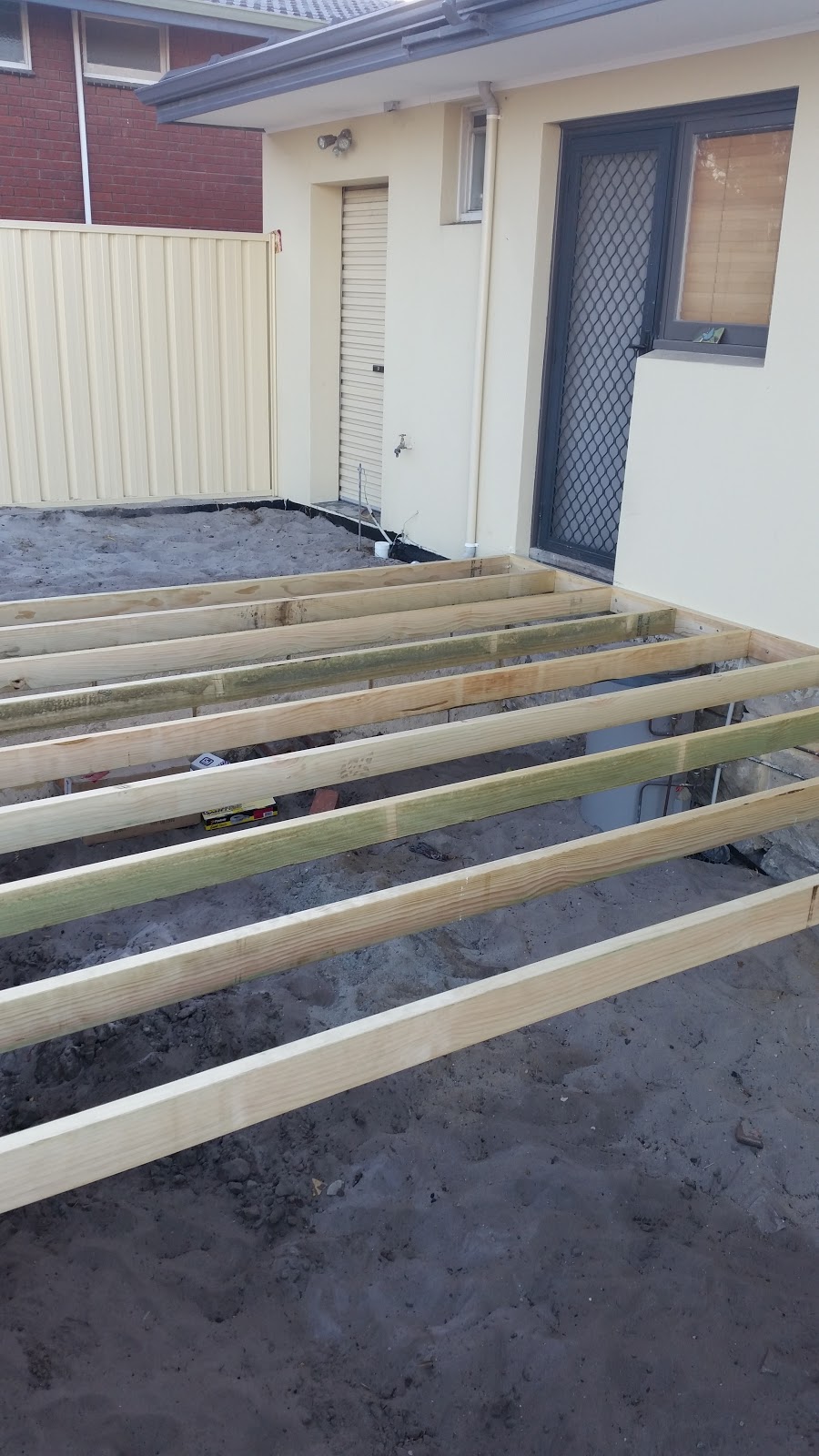
Firstly, the carpenter built a treated pine wood frame all around the inside of the retaining wall structure and then support beams were attached to the frame.


Then he added both pine stumps and metal supports which were concreted in underneath the deck to add further support to the deck above.


Once all the frame work was in the timber deck was laid on top of the frame - we went for a natural timber in Merbau hardwood which is a dark brown wood similar to Jarrah and will compliment our Jarrah floorboards well.

There are two sizes to pick from - thin or wide boards and as it's a big space we went for the wide board in 140mm - a smaller space would look better with a thin board.

We thought about using a composite plastic deck material but it would be more expensive and because our deck is undercover of the patio and protected it won't be exposed to the elements so the natural timber will keep in great condition. If the deck was not covered and exposed to the elements we would've paid the extra money and gone with a composite plastic deck material.

The natural timber will still need to be oiled and sealed to protect it and I'll be doing a DIY How to oil a deck blog post using some awesome outdoor products from Cabots.


You can see how the deck is all on the same level as the dining room french doors and the laundry door so when we step out of the house the deck will be like an outdoor room and extension of the house.

The sandy patch below that steps down to our garage door (which is at a lower level) we are going to lay pavers and lawn here so the backyard is dog friendly for our rescue dog Lexi.


Once the carpenter started laying the timber boards the deck was built pretty quickly.

A trap door was also made with a staircase going down underneath to access under the house which we can use for storage and to access the house for any plumbing or other maintenance needs. A lid was made for the trap door with a flush handle fitted to lift it up. The trap door was my clever idea and I think it's a great addition and the workmanship is seamless you can hardly notice it's there!


So that's it - the deck is done!


Next we need to oil and seal the timber deck to protect it and as mentioned I'll be writing a DIY How to oil a timber deck blog post using some awesome outdoor products from Cabot's just as soon as we've done this (our next DIY weekend project)!

The next project underway is the carpenter building a patio over the top of the deck which I'll share in a separate blog post very soon.

Do you have a deck? 
What deck material did you use - natural timber or a composite material? 

Sharing with link parties:
Curly Crafty Mom - The Creative Corner
The Dedicated House - Make It Pretty Monday
Savvy Southern Style - Wow Us Wednesdays


 photo F0F68C01A59FABD46732FC15E1D8816D_zpsc6047f2f.png

For exclusive extras and daily updates ... follow Jarrah Jungle on Facebook, Instagram and Twitter


[All images my own]

Pin It Now!